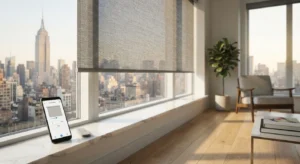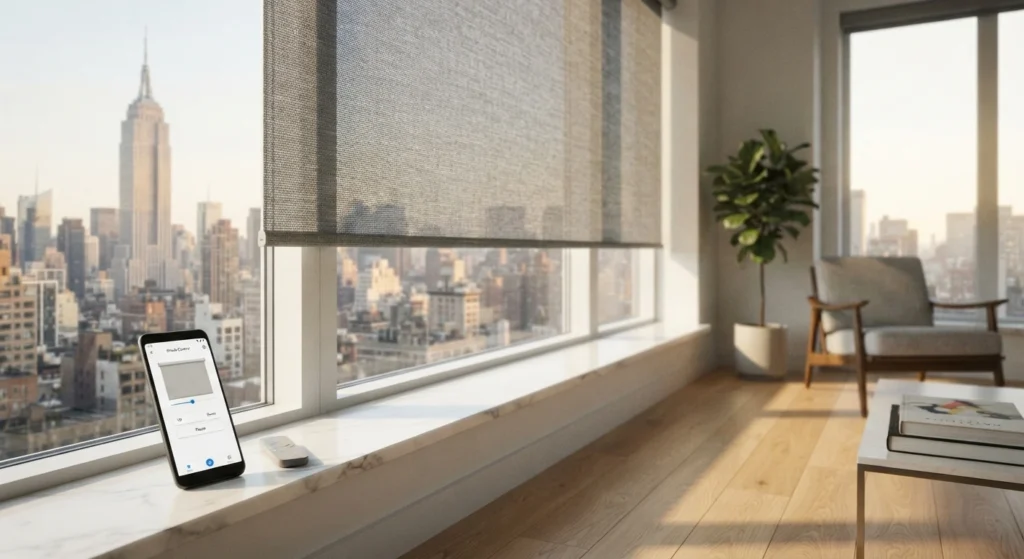
Smart shades are motorized window treatments that can open, close, or move to a selected position automatically. Instead of pulling a cord or manually adjusting each window, you can control the shades with a remote, wall keypad, smartphone app, scheduled routine, or compatible smart-home system.
For homeowners considering smart shades in NYC, the main attraction is not simply motorization. The real advantage is being able to manage natural light, privacy, glare, and window coverage throughout the day without adjusting every shade individually.
A properly planned system can raise the bedroom shades in the morning, lower west-facing shades during strong afternoon sun, close privacy shades in the evening, and adjust several windows together with one command.
Smart Shades vs Motorized Shades: Is There a Difference?
The terms are often used interchangeably, but there can be a difference.
Motorized Shades
A motorized shade has a small electric motor that moves the window covering. It may be operated only with a remote control, wall switch, or keypad.
Smart Shades
Smart shades add automation and connectivity. Depending on the system, they may support smartphone apps, schedules, scenes, voice assistants, smart-home integration, sunrise and sunset routines, and automated positioning.
Modern systems can combine remote, app, voice, and scheduled controls rather than limiting the user to one operating method.
The motor physically moves the shade. The smart controls determine when and how it moves.
How Does a Smart Shade Actually Work?
A typical smart-shade system has several basic components.
1. The Shade
This is the visible window treatment. Smart operation can be incorporated into several styles, including roller shades, cellular shades, Roman shades, woven shades, sheer shades, and certain blinds and drapery systems.
The fabric still determines how much light and privacy the shade provides.
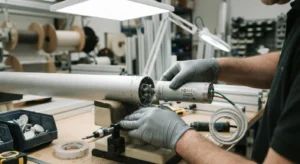
2. The Motor
A compact motor is installed within or alongside the shade mechanism. When it receives a command, the motor rotates the tube or drive system that raises or lowers the covering.
Better systems can also stop at selected positions instead of operating only fully open or fully closed.
3. The Power Source
The motor needs electricity. Depending on the installation, that may come from replaceable batteries, rechargeable batteries, plug-in power, or low-voltage hardwiring.
Both battery-powered and hardwired systems are widely available.
4. The Control System
Commands may come from a handheld remote, wall keypad, smartphone, automation hub, voice assistant, or programmed schedule.
Together, these parts turn an ordinary window treatment into an automated system.
Battery-Powered Smart Shades
Battery-powered shades are especially useful in existing NYC apartments because they can often be installed without opening walls to run new electrical wiring.
The batteries are typically hidden inside or near the headrail.
Advantages of Battery Power
- Little or no electrical work
- Cleaner retrofit installation
- No visible power cable in many installations
- Suitable for finished apartments
- Easier installation on existing windows
Some wireless systems are specifically designed for retrofit installations and do not require power or control wiring inside the walls.
How Often Do the Batteries Need Replacement?
Battery life varies according to shade size, motor, fabric weight, frequency of operation, wireless communication, and battery type.
Some current wire-free systems are engineered for multiple years of battery life under typical conditions, although actual results depend on the installation and usage.
Rechargeable systems provide another option when regular disposable battery replacement is undesirable.
Hardwired Smart Shades
Hardwired shades receive power through wiring built into the property.
This can be an attractive solution during new construction, major apartment renovation, whole-home remodeling, or high-end automation projects.
The wiring is usually concealed in the walls or ceiling.
Why Choose Hardwiring?
Hardwired systems avoid periodic battery replacement and can work particularly well when many windows are being automated at once.
They can also be practical for shades that are very large, difficult to reach, installed high above the floor, or used frequently.
Current smart-shade systems offer both low-voltage wired and battery-powered configurations depending on the project.
The Best Time to Plan Wiring
If walls are already open during renovation, plan the shade system before drywall and finishes are completed. Retrofitting concealed wiring afterward can require more work.
How Do You Control Smart Shades?
One of the biggest advantages of automation is having several control methods available.
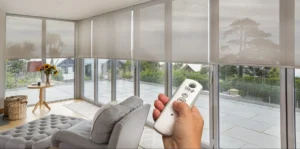
Remote Control
A remote is the simplest approach. You may be able to control one shade, one room, or several grouped shades.
This is useful for anyone who wants motorization without relying on a phone.
Wall Keypad
A keypad provides a permanent control point. It may include commands such as open, close, 50%, privacy, or evening.
Keypads work particularly well in larger homes and rooms with several automated windows.
Smartphone App
An app can usually provide much more detailed control. Depending on the system, you may be able to open or close shades, select exact positions, group rooms, create schedules, save favorite scenes, and check battery information.
Modern smart-shade platforms can also provide position controls and battery notifications through their apps.
What Are Smart-Shade Scenes?
A scene is a saved combination of positions.
Instead of adjusting five shades individually, you activate one command.
Morning Scene: Bedroom shades open, living-room shades at 60%, media-room shades closed.
Movie Scene: TV-facing shades closed, other living-room shades partially closed.
Evening Privacy Scene: Street-facing shades closed, interior courtyard shades remain open.
Current automated systems allow users to create scenes and then activate them manually or place them on a schedule.
This is where smart shades begin to feel substantially different from simply pressing a motorized-shade button.
Smart Shades Can Run on a Schedule
Schedules allow the shades to operate without a manual command. For example:
| Time | Shade Position |
|---|---|
| 7:00 AM | Bedroom shades open |
| 9:00 AM | Living-room shades open |
| 3:00 PM | West-facing shades lower |
| Sunset | Street-facing shades close |
| 10:30 PM | All bedroom shades close |
Some systems can also work with sunrise and sunset instead of a fixed clock time.
That allows the routine to shift naturally as daylight hours change during the year.
Why Smart Shades Work Well for NYC Apartments
New York apartments can have very different window conditions within the same room.
A high-rise apartment may receive strong morning sunlight, harsh afternoon glare, views into neighboring buildings, street-level privacy concerns, and large expanses of glass.
Automated shades make it easier to respond to these changes without repeatedly walking from window to window.
Common NYC Uses Include
- Managing street-facing privacy: program shades to lower automatically in the evening.
- Controlling high-rise glare: lower specific windows during the strongest part of the day.
- Handling hard-to-reach windows: motorization eliminates the need to manually reach tall or awkward glazing.
- Coordinating several large windows: multiple shades can be grouped so they move together.
Some motorized systems are designed specifically to keep several shades aligned as they move, even when the windows differ in size.
Can Smart Shades Help Control Sunlight and Heat?
Yes, but the fabric choice matters just as much as the motor.
The motor only changes the position of the shade. The fabric determines what happens to incoming light.
Solar or screen fabrics can help reduce glare, filter sunlight, and preserve some exterior views.
Light-filtering fabrics diffuse daylight without fully darkening the room.
Blackout fabrics provide much stronger light control for spaces such as bedrooms, media rooms, and nurseries.
Some roller systems can also use side channels to reduce light entering around the edges of blackout material.
Choosing the right fabric is therefore as important as choosing the automation technology.
Can Smart Shades Improve Privacy?
Yes. One of the most practical uses of automated shades is making privacy predictable.
Instead of remembering to close every window each evening, you can create a routine — for example, sunset triggers all street-facing shades to close.
This can be particularly useful in NYC apartments where windows face neighboring towers, courtyards, sidewalks, or nearby rooftops.
Automated schedules are specifically used in modern systems to increase privacy by closing window treatments at predetermined times.
Can They Work With Voice Assistants?
Many systems can.
Depending on the platform and integration, you may be able to use commands such as “Close the living-room shades” or “Set the bedroom shades to 50 percent.”
Current smart window-treatment systems support integrations with major voice and home-automation platforms.
A Smart-Home Hub May Be Needed
Not every motor communicates directly with every voice assistant. Some systems require a bridge or hub between the shades and the broader smart-home network.
A typical setup may look like: shade → wireless control system → smart hub → app/voice platform.
Compatibility should be checked before selecting the motor rather than after installation.
Can Smart Shades Work With Smart Lighting?
Yes, and this is one of the more useful whole-home applications.
Natural and electric light can be controlled together. For example, shades rise while electric lights dim in the morning, sun-facing shades lower while interior lighting adjusts in the afternoon, and shades close with room lighting changing together for a movie-night scene.
Some current systems are specifically designed to coordinate automated shading with intelligent lighting.
For a larger smart-home project, planning both systems together can create a more consistent result.
What About Sun Sensors and Automatic Adjustment?
More advanced systems can respond to environmental conditions or changing sun position.
Instead of a fixed rule like “close at exactly 3 PM,” the system may adjust shades based on sun position, time, scene, or integrated sensor data.
Some current smart-shading technologies include location-aware functions that adjust shades as sunlight changes throughout the day.
This can be particularly helpful for large south- or west-facing windows.
Are Smart Shades Noisy?
Motor noise depends on the system.
Higher-quality motors are designed for quieter operation because shades are often used in bedrooms, offices, conference rooms, and living rooms.
Some current architectural motorized-shade systems document operating sound as low as approximately 38 dBA for certain configurations.
The actual sound level depends on shade size, motor, installation, fabric, and mounting conditions.
If quiet operation is important, ask about motor specifications before purchasing.
Do Smart Shades Still Work if Wi-Fi Goes Down?
Often, yes, depending on the system.
A well-planned installation may retain local controls such as a remote, keypad, or shade button, even when internet-based features are unavailable.
The exact behavior differs between manufacturers and control systems.
This is another reason to avoid designing a shade system that depends only on a smartphone app.
Keep a Simple Manual Control Option
Even in a highly automated home, a remote or wall keypad remains useful. Guests should not need your Wi-Fi password, your phone, or a smart-home account just to lower a window shade.
Are Smart Shades Good for Large Windows?
They can be especially useful for large windows because manually operating a wide or heavy shade can be inconvenient.
However, motor and shade specifications need to match width, height, fabric weight, tube size, and mounting conditions.
Current motorized roller systems include specialized options for very wide openings and unusual window shapes.
Large-window systems should therefore be measured and specified professionally rather than assuming one motor fits every shade.
What About Child and Pet Safety?
Cordless motorization eliminates the traditional dangling lift cords used on many older window treatments.
That can create a cleaner appearance and reduce cord-related hazards.
Modern motorized shade guidance specifically identifies the absence of dangling cords as a safety benefit for households with children and pets.
This is useful even for homeowners who have little interest in advanced automation.
What Should You Decide Before Installing Smart Shades?
Use this checklist before selecting a system.
Window treatment: Roller, cellular, Roman, or other compatible style.
Fabric: Solar, light-filtering, privacy, or blackout.
Power: Battery, rechargeable, plug-in, or hardwired.
Control: Remote, wall keypad, app, voice, or scheduled automation.
Smart-home integration: Existing platform identified, hub requirements confirmed, lighting integration considered, Wi-Fi/local-control behavior understood.
Planning these decisions together produces a much better result than picking a fabric first and trying to add automation afterward.
Make the Window Treatment Part of the Smart Home
Smart shades in NYC combine a motorized window treatment with controls that can include remotes, wall keypads, smartphone apps, voice commands, schedules, scenes, and broader smart-home automation. Battery-powered systems can make retrofits practical in finished apartments, while hardwired systems are often worth considering during renovation or new construction. The right fabric and control strategy can then help manage daylight, glare, privacy, and window coverage throughout the day.
At Manhattan Shades, we design and install custom smart and motorized shades for residential and commercial spaces throughout New York City. We can help match the shade style, fabric, motor, power source, controls, and smart-home integration to the way you want each room to function, whether you need simple remote operation or a fully automated shading system. Our breakdown of how motorized shades work covers the mechanics in more depth, and you can contact us for a free consultation whenever you’re ready to plan your system.