Window treatments affect how a space looks, how much light comes in, how much heat builds up, and how much privacy you have. For New York City properties, where windows face other buildings, busy streets, and varying sun angles throughout the day, the choice between smart and traditional shades is a practical one, not just a style decision. If you are weighing smart shades in NYC against a standard cordless or manual option, this guide covers what actually separates the two and which one fits different types of spaces.
What Traditional Shades Cover and Where They Work Well
Traditional shades operate manually through a cord, chain, or cordless lift mechanism. They come in a wide range of fabrics, opacities, and styles, including roller shades, cellular shades, Roman shades, and solar shades. The mechanism is simple, the cost is lower than motorised options, and installation is straightforward.
For NYC apartments and smaller commercial spaces with a limited number of windows, traditional shades handle the basic requirements well. Light control, privacy, and temperature management are all achievable with the right fabric choice and opacity level. A blackout roller shade in a bedroom does the same light-blocking job as a motorised blackout shade.
Where traditional shades fall short is in convenience and control at scale. In an apartment with ten windows, adjusting shades in every room manually throughout the day is a chore. In a commercial space with floor-to-ceiling glazing across a south-facing wall, manual adjustment is impractical for managing sun glare during working hours.
What Smart Shades Add Beyond Manual Operation
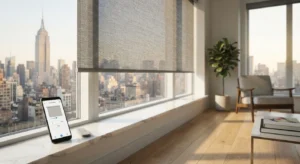
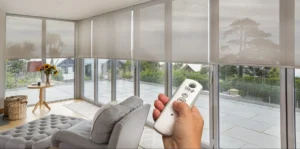
Smart shades use a motorised mechanism controlled through a remote, a wall switch, a smartphone app, or integration with a building automation system. The motorisation is the core feature, and everything else builds from it.
Scheduling and Automation
Smart shades can be programmed to open and close at set times. For an office in Midtown that gets direct sun on south-facing windows, shades can drop automatically at the start of that window and rise again when the sun angle changes, without anyone in the space needing to act. For a residential apartment, shades rising with sunrise and closing at a set evening time removes the need to interact with them at all.
Integration With Lighting and HVAC
When connected to a building automation or smart home system, shades work alongside lighting and temperature systems. Closing shades on the sunny side of a building reduces heat gain, which reduces the load on the HVAC system during summer. According to the US Department of Energy, window coverings can reduce heat gain by up to 77 percent, depending on the product type and placement. For commercial properties in NYC managing energy costs under Local Law 97, this kind of passive thermal management contributes to the building’s overall performance.
Read More: Manual vs Motorized Shades
Remote Access and Group Control
For a large commercial space or a multi-zone residential property, controlling all window treatments from a single interface removes the friction of adjusting each one manually. Hotel operators, office managers, and property developers working with floor plans that include dozens of windows find motorised group controls a practical necessity rather than an add-on feature.
Cost Comparison: Smart vs Traditional Shades in NYC
This is where the conversation usually stalls. Smart shades cost more upfront than traditional options, and the gap is significant when you are outfitting multiple windows.
A basic cordless roller shade in NYC typically runs from $80 to $200 per window installed, depending on size and fabric. A motorised smart shade from a mid-range brand runs from $300 to $700 per window installed before any hub or integration costs. Premium brands with full home automation compatibility push that higher.
For a single-bedroom NYC apartment with six to eight windows, the cost difference between traditional and smart shades is a few thousand dollars. For a commercial space with 30 or more windows, that difference scales substantially.
The offsetting factor is long-term value. Motorised shades in NYC on a commercial property that reduce HVAC load generate energy savings that accumulate over the years. For property owners operating under NYC’s energy performance requirements, this has a direct financial impact beyond comfort.
Which Type Fits Which Space
Traditional shades work best for:
- Residential apartments with a small number of windows
- Rental properties where the owner wants a lower upfront cost
- Spaces where automated control adds no practical benefit
- Budget-focused renovations where manual operation is acceptable
Smart shades work best for:
- Commercial offices, hotels, and large residential properties with many windows
- Properties connected to a smart home or building automation system
- NYC buildings focused on energy performance and HVAC efficiency
- High-end residential spaces where convenience and integration are priorities
Fabric and Opacity Still Matter Regardless of Which Type You Choose
The shade mechanism, smart or manual, does not determine how well the shade manages light. Fabric selection does. A sheer fabric on a motorised shade gives you the automation but not the privacy or blackout function. A solar screen fabric reduces glare and heat gain, whether it is on a cordless roller or a motorised system.
For window shade installation in NYC properties, getting the fabric choice right for the window orientation and the room’s function matters as much as the mechanism. A south-facing conference room needs a solar screen or a room-darkening fabric to manage afternoon glare, regardless of whether the shade is motorised.
Get the Right Window Shades for Your NYC Property With Manhattan Shades
Manhattan Shades handles smart shades in NYC and traditional shade installation for residential apartments, commercial offices, hotels, and retail spaces across New York City. If you are trying to figure out which system fits your space and budget before committing, contact us, and we will assess your windows, your light conditions, and your priorities and recommend the right solution without overselling features you do not need.